LED posters
LED poster cabinet types explained
Every LED poster we build uses the same 320 × 160 mm modules, and the screen sizes are the same from one type to the next: 640 × 1920 mm, 960 × 1920 mm, and 1280 × 1920 mm for the tri-fold. What changes is the cabinet. The cabinet decides how you service the poster, how the LEDs are protected, whether several posters can join into one screen and how the poster folds and travels. The picture quality comes from the pixel pitch, not from the cabinet. All of them are direct-view LED, not LCD kiosks.
- Same modules, same sizes
- Front or rear service
- GOB or acrylic glass
- Daisy chain or standalone
- Folding and double-sided options
| What the cabinet changes | What it decides |
|---|---|
| Service side | Whether a module is changed from the front or through a rear cover |
| LED protection | GOB coating over the LEDs, or an acrylic glass screen in front of them |
| Daisy chain | Whether several posters can run as one screen |
| Folding and transport | Whether the poster folds, and how it packs |
| Base | Casters or stand |
What is a cabinet type?
A cabinet type is the enclosure that holds the LED modules, power supplies and electronics of the poster. In our range the module is the same in every indoor type, so two posters of the same size and pitch show exactly the same picture. The cabinet is what makes them different to live with: how you open them, how they are protected, how they join and how they move.
Die-cast aluminum, front service
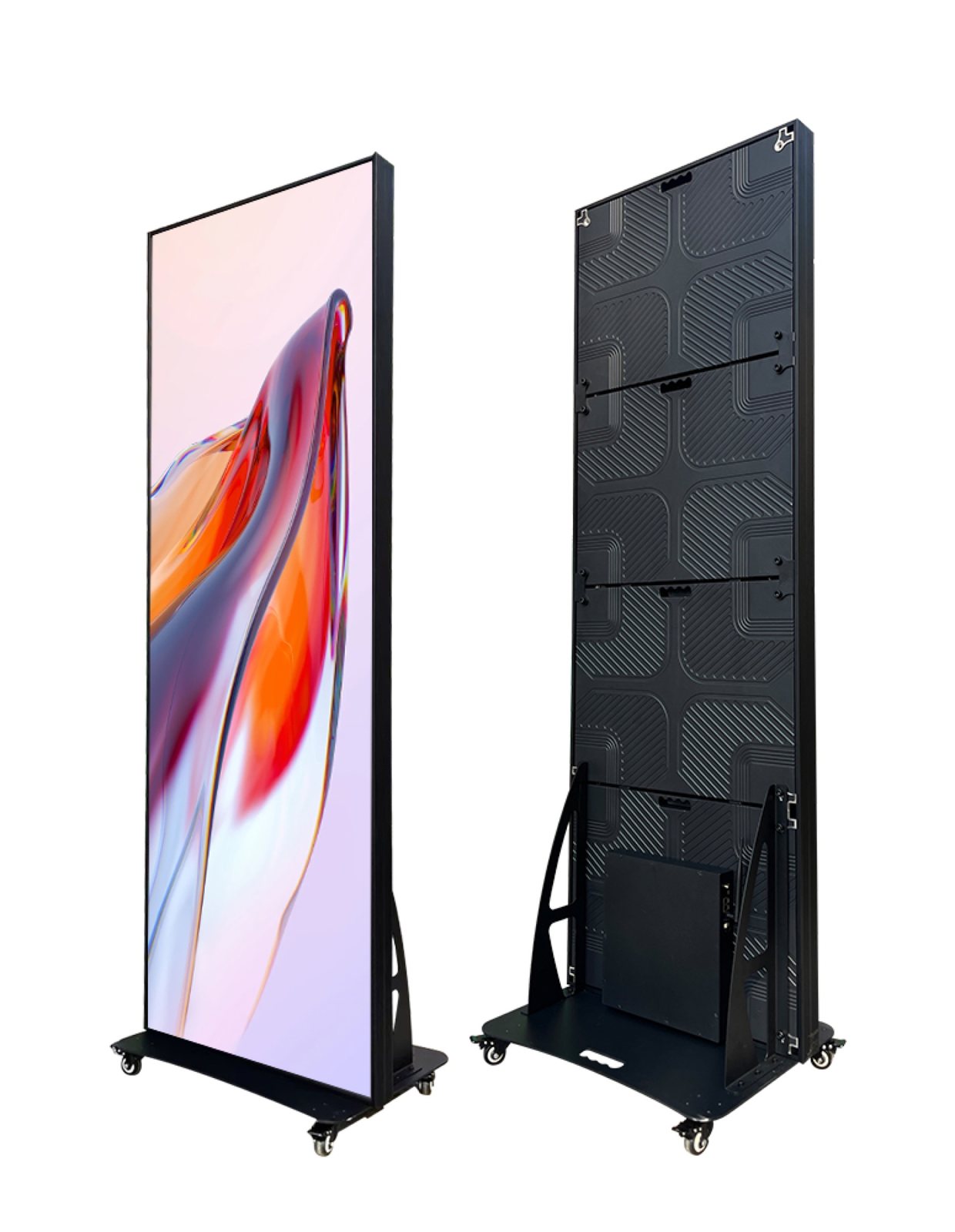
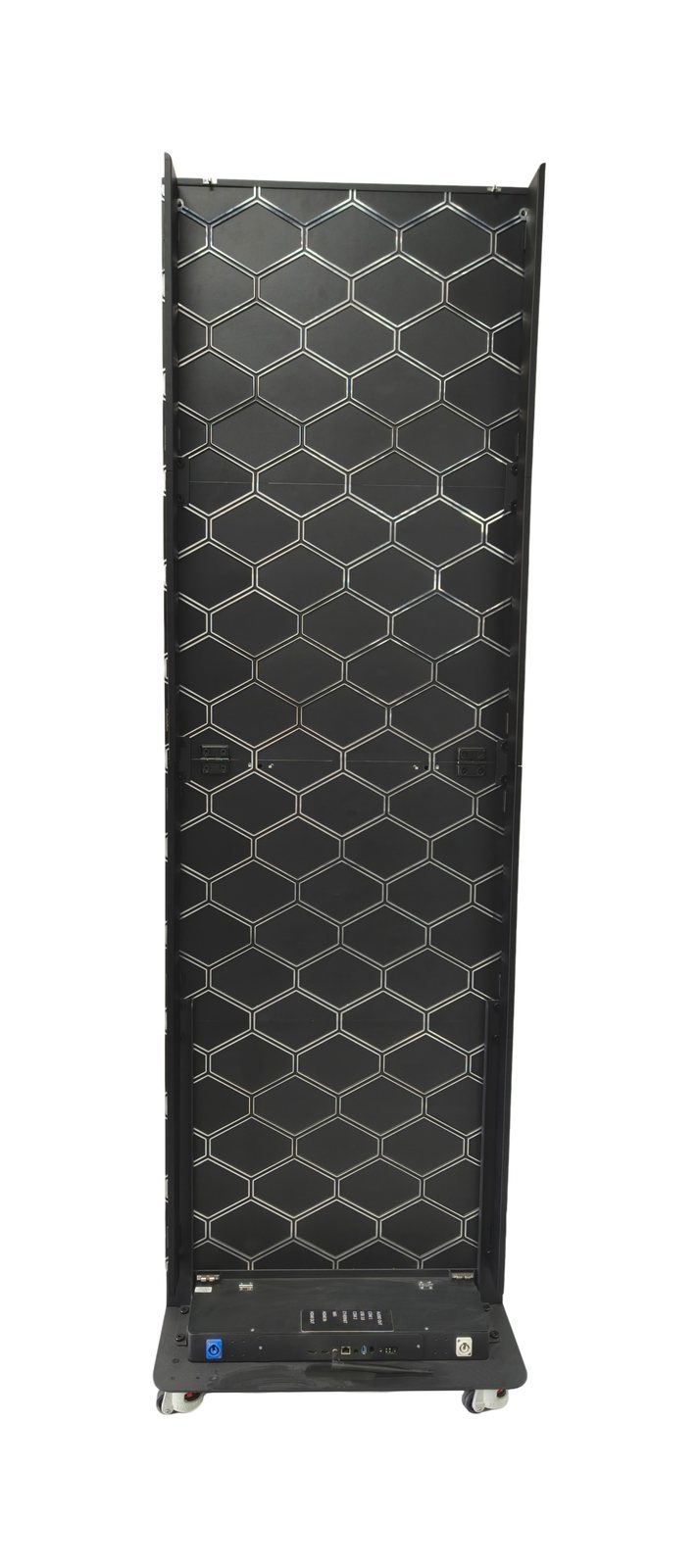
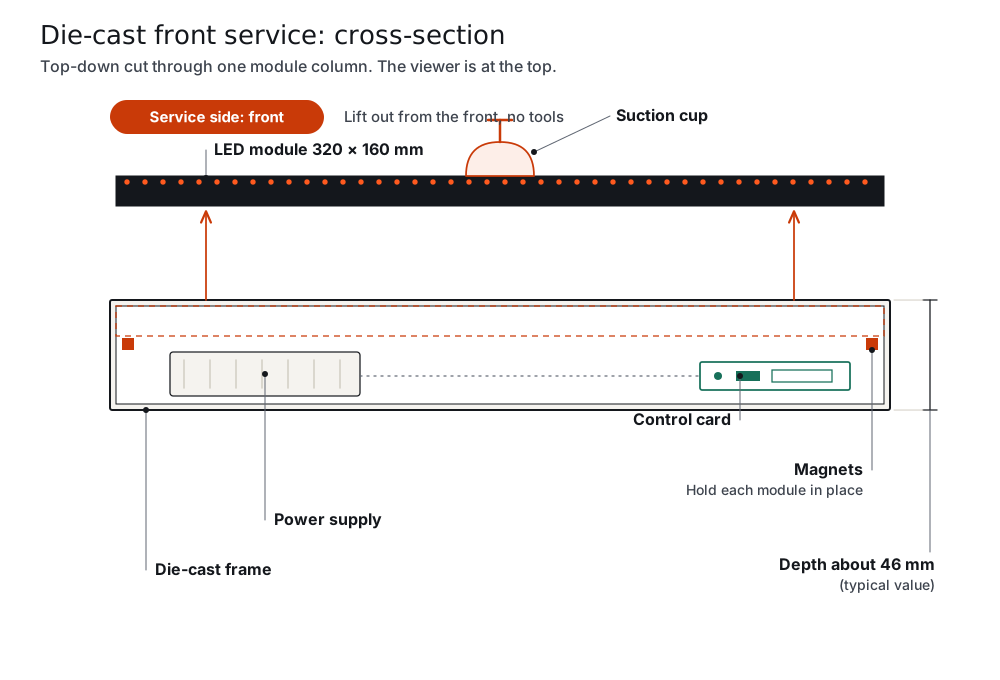
The cabinet is die-cast aluminum. With front service, each module is held by magnets and lifted out from the front with a suction cup, with no tools. You do not turn the poster around or open a rear cover to change a module. Die-cast gives accurate joint geometry between cabinets, which suits daisy-chained walls. GOB is included and casters are standard on the 640. The die-cast 640 is joinable and foldable.
Choose it when modules may need changing on site, when you plan to join several posters, or when the poster will be moved often. See the die-cast LED poster, 640 mm and wide die-cast LED poster, 960 mm.
Aluminium profile cabinet with rear door
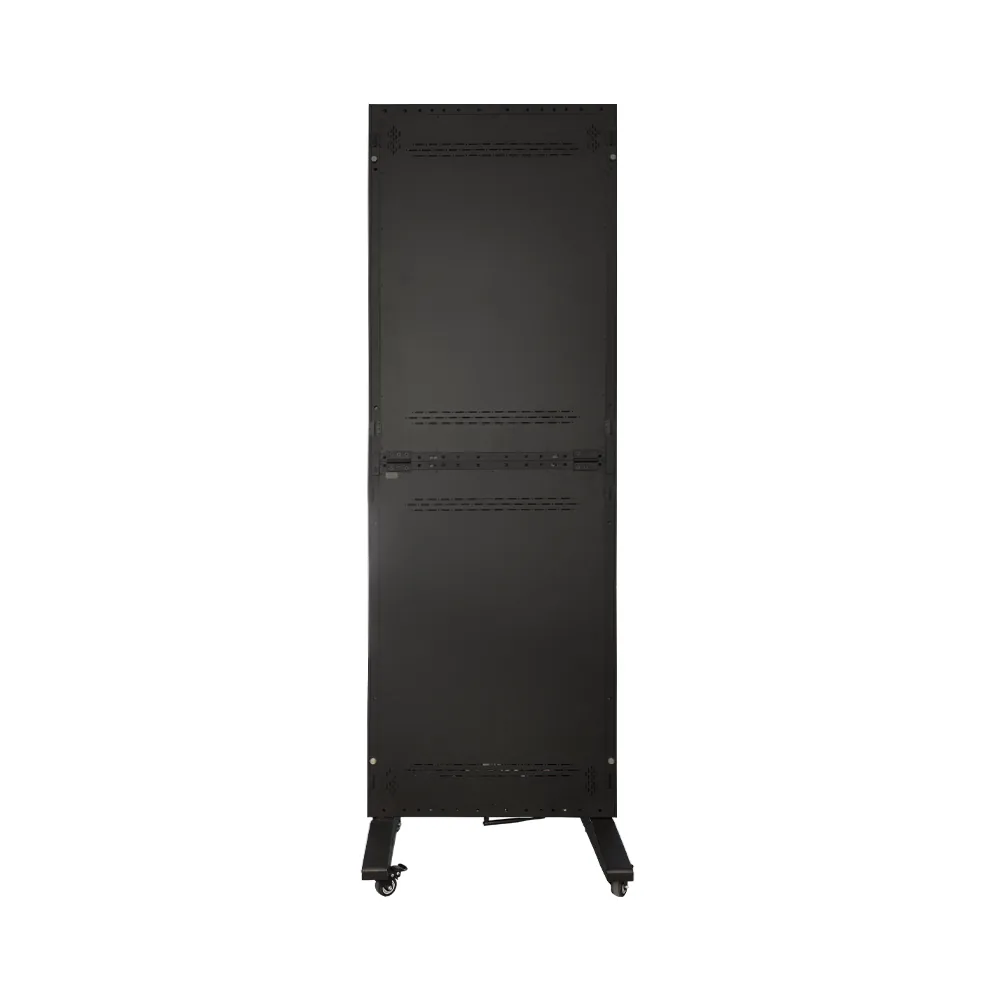
The rear door is a feature of one cabinet only: the aluminium profile cabinet of the Indoor 640, which stands on a folding rear stand. On this poster the modules are serviced from the back through the door. Plan roughly 30 to 50 cm of clear space behind it, or roll it away from the wall on its casters before you open it. The die-cast cabinet, in both the 640 and the 960, is front service only and has no rear door. See the Indoor 640 page.
Acrylic glass screen
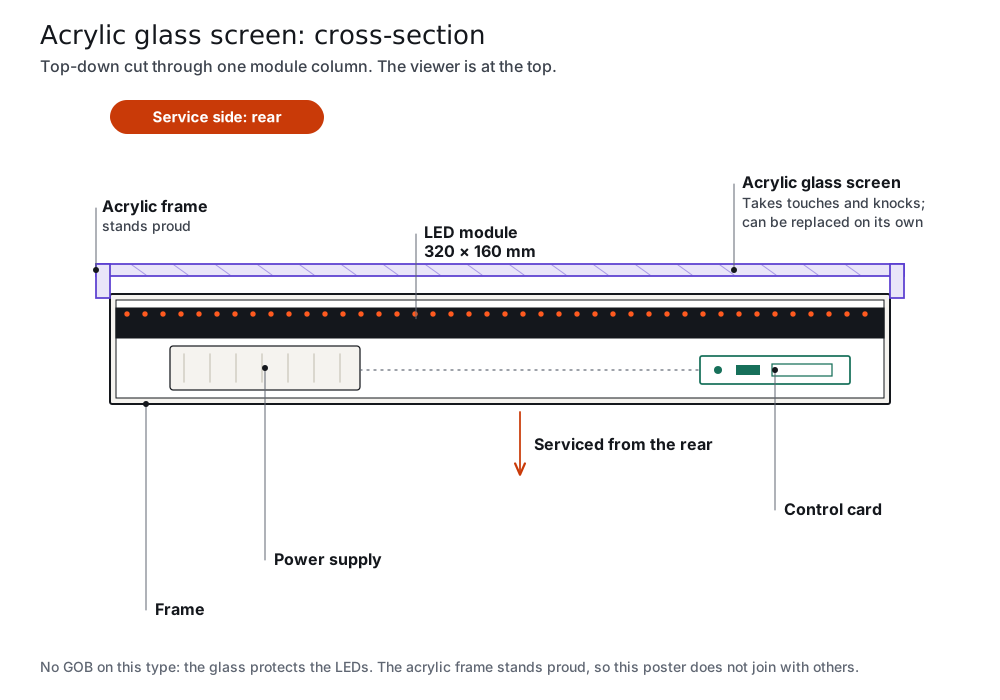
A protective acrylic glass screen sits in front of the modules instead of GOB. The glass takes touches and knocks, and it can be replaced on its own if it is marked. Service is from the rear. The acrylic frame stands proud of the cabinet edge, so this poster cannot be joined with others. It is the lowest-cost indoor type: choose it when price matters most and the poster stands alone. To upgrade later, move to a die-cast poster, which is a different type. See the LED poster with acrylic glass screen.
Double-sided
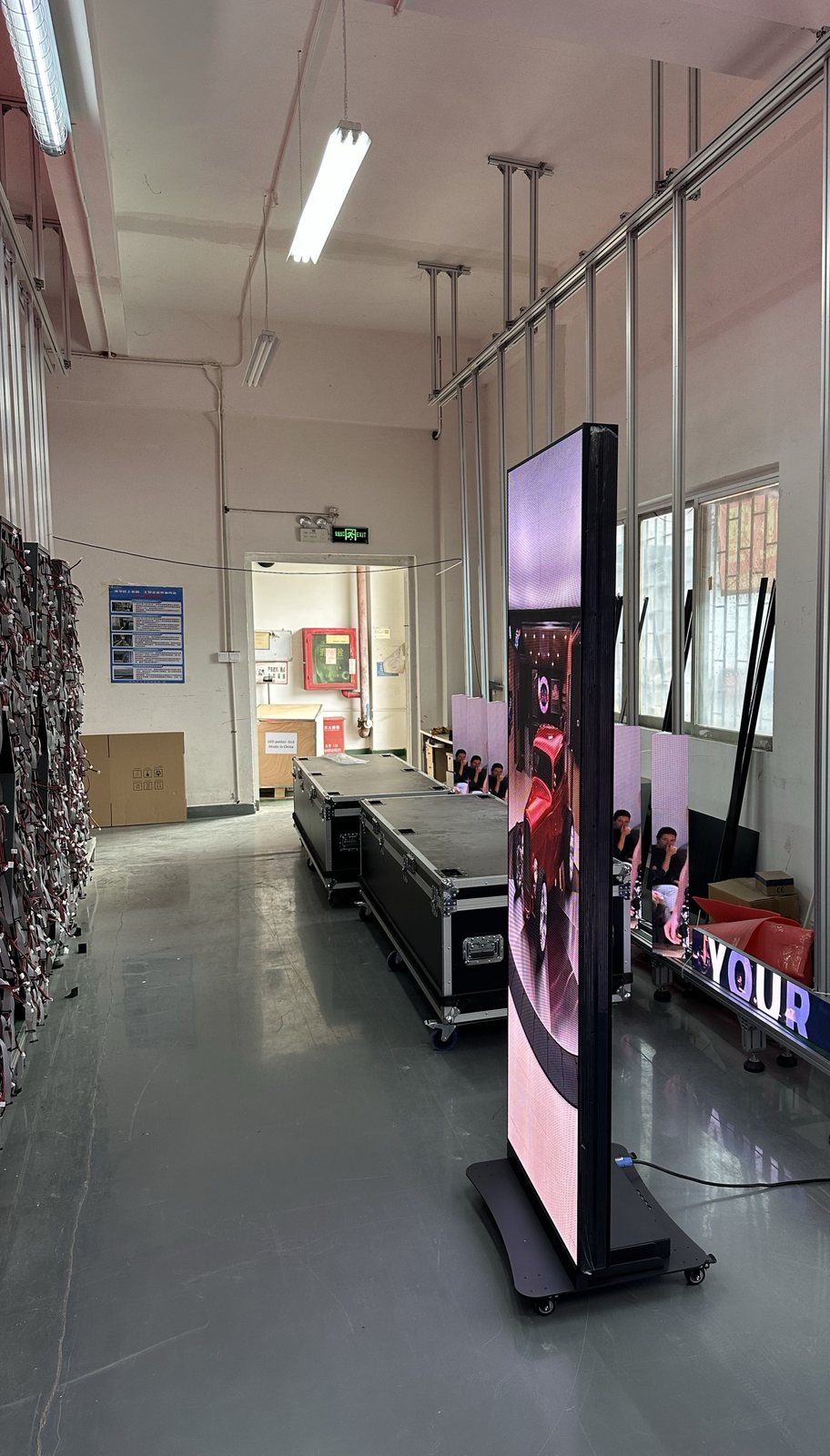
Two independent screens back to back in one die-cast cabinet, with front service. It does not join with other posters. See the double-sided LED poster.
Tri-fold
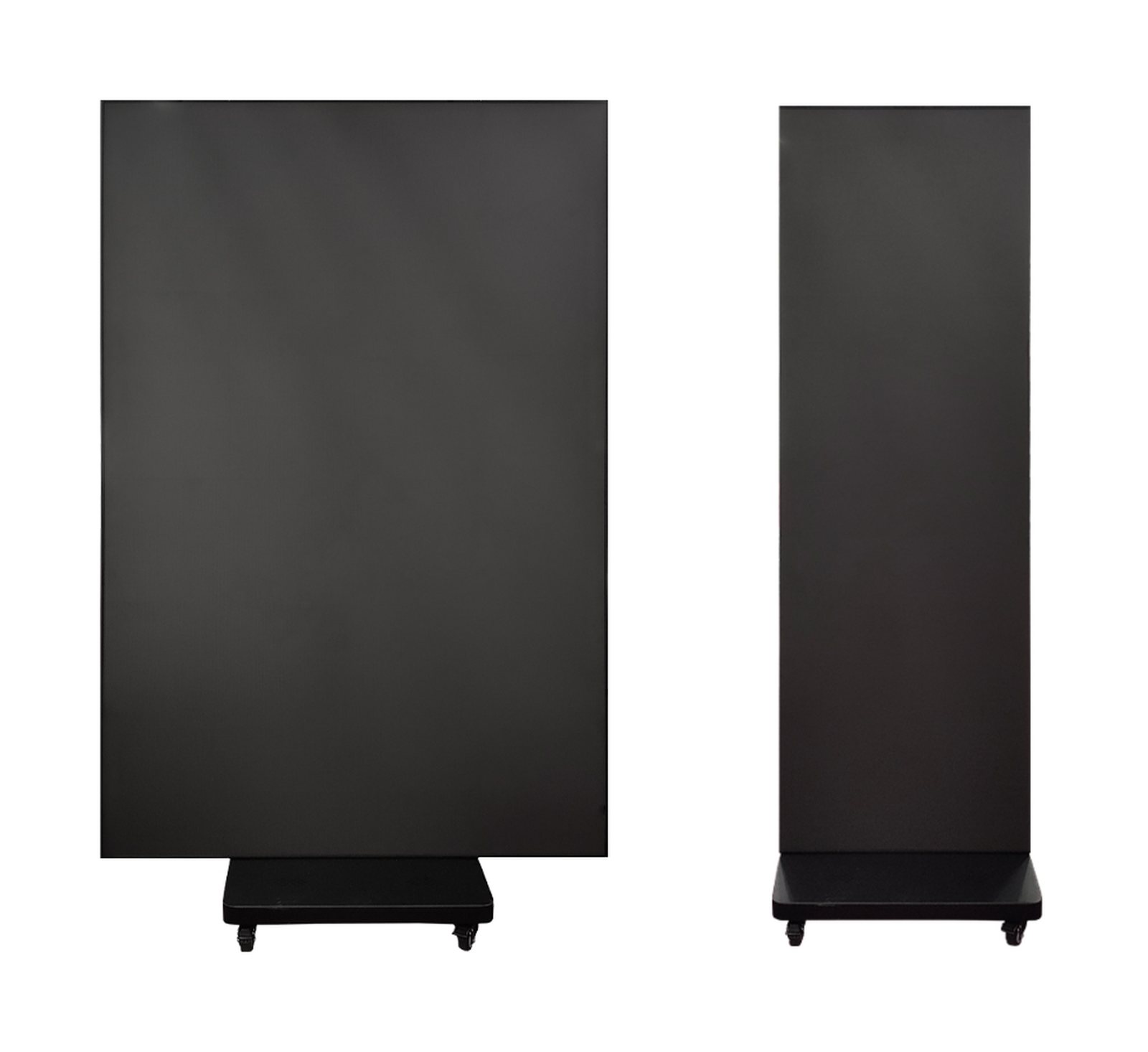
An aluminum-profile frame with hinges and three panels (320 + 640 + 320 mm). Open, it is a 1280 × 1920 mm screen. Folded, it is about 640 mm wide. Folded it fits a narrow position, open it is a wide backdrop. Rear service, GOB included. Open tri-fold posters can be daisy-chained into a wider wall. See the folding tri-fold LED poster.
Outdoor
The outdoor poster comes as a fixed, a foldable and a die-cast foldable version, all serviced from the back and all joinable. It starts at 4500 nit and is built for outdoor use. See the outdoor LED poster, 640 mm.
Side by side
| Die-cast (front service) | Acrylic glass screen | Double-sided | Tri-fold | |
|---|---|---|---|---|
| Sizes | 640 or 960 × 1920 mm | 640 × 1920 mm | 640 × 1920 mm | 1280 × 1920 mm open |
| Resolution at P2.5 | 256 × 768 or 384 × 768 | 256 × 768 | 256 × 768 per face | 512 × 768 |
| Service | Front (magnets) | Rear | Front | Rear |
| LED protection | GOB | Acrylic glass | GOB | GOB |
| Daisy chain | Yes | No | No | Yes |
| Folds | Yes (640) | No | No | Yes |
| Casters | Yes | Yes | Yes | Yes |
GOB in plain words
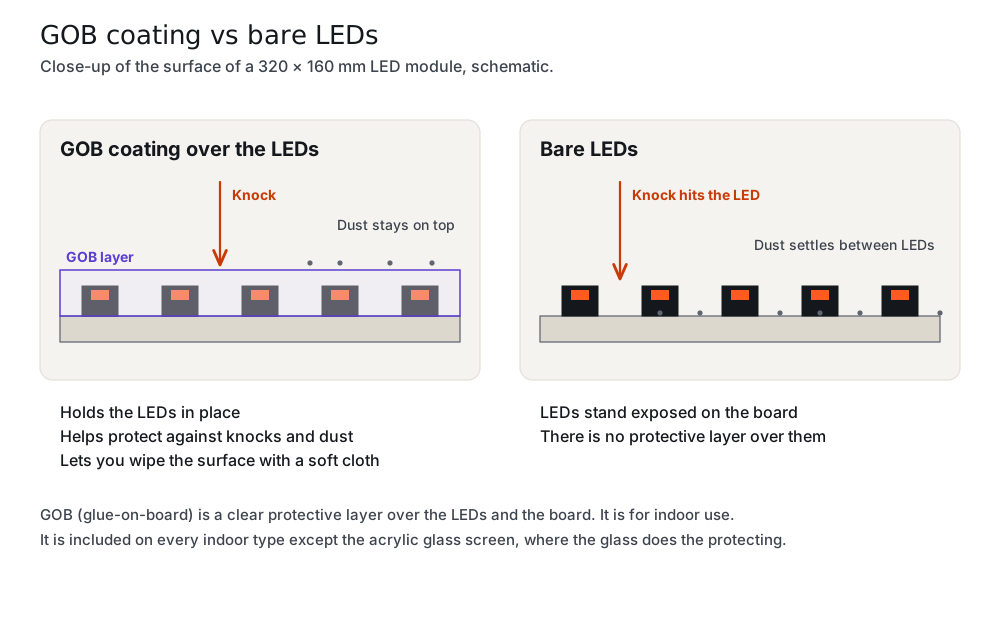
GOB (glue-on-board) is a clear protective layer over the LEDs and the board. It holds the LEDs in place, helps protect them against knocks and dust, and lets you wipe the surface with a soft cloth. It is for indoor use and does not turn the poster into a wet-area or outdoor product. GOB is included on every indoor type except the acrylic glass screen, where the glass does the protecting.
Front service and rear service in plain words
Front service saves time: a module comes out in front of you and the poster stays where it is. Rear service is a normal way to build a cabinet, but it needs room behind the poster and an extra step to open the rear cover. If you will rarely open the poster, or the back is easy to reach, rear service is enough. If you expect to swap modules often, or the poster stands in a tight spot, front service is the better fit.
How to choose
| If this describes your project | Look at |
|---|---|
| You will join several posters, or move the poster often | Die-cast LED poster, 640 mm with front service |
| You need a wider canvas than 640 mm | Wide die-cast LED poster, 960 mm, or the folding tri-fold LED poster |
| The back of each poster is reachable | LED poster 640 mm, aluminium profile cabinet with rear door |
| People may touch the screen, or price matters most | LED poster with acrylic glass screen |
| Visitors approach from two sides | Double-sided LED poster |
| The screen must travel folded and open wide at the venue | Folding tri-fold LED poster |
| The poster stands outdoors | Outdoor LED poster, 640 mm |
Questions buyers ask about cabinets
Can I upgrade an acrylic poster to GOB later?
No. The acrylic glass screen is part of its cabinet. If you want GOB and the option to join posters, choose a die-cast poster at the start.
Can I join posters from different types in one screen?
Pitches never mix in one chain. Posters of different cabinet types are not planned as one screen by default: tell us what you have in mind, and since the limit is the total pixel count the controller can drive, we calculate what can be joined.
Which cabinets can be spliced into a wall, and which stand alone?
The die-cast and tri-fold posters can be chained into walls; the number of posters in one cascade is set by the total pixel count the controller can drive, so it depends on the pitch, and we calculate it for your layout. The double-sided and the acrylic posters stand alone; the acrylic frame protrudes, so it cannot sit tight against another poster.
Is a pylon or a totem a different cabinet from an LED poster?
No. Pylon, totem and standee are words that different markets use for a freestanding screen. Ours are direct-view LED posters, not LCD kiosks, and every cabinet on this page is one way of building them.
Is front service worth it if my poster will rarely be opened?
If you will open the poster once or twice in its life, rear service does the job. Front service pays off with many posters, frequent swaps, or tight spaces where turning a heavy poster is awkward.
Does a different cabinet change the picture quality?
No. The modules are the same 320 × 160 mm modules, so the pixel pitch and resolution follow the pitch you choose, not the cabinet. At P2.5 a 640 × 1920 mm poster is 256 × 768 pixels in every type. The cabinet changes service, protection, joining and folding.
Which cabinet is easiest to ship and store?
The tri-fold and the foldable die-cast 640 fold for transport. Flight cases for 1 to 4 posters and wooden crates are Optional; see packaging and shipping.
What does the acrylic glass protect against?
It takes touches and knocks in front of the modules and can be replaced on its own. It is for indoor use. Do not treat it as protection against outdoor weather.
What is GOB, and does every type have it?
GOB is a clear protective layer over the LEDs. It is included on every indoor type except the acrylic glass screen, where the glass does the protecting. The outdoor poster has its own outdoor build and does not use this description.
Request a quote
Request a quote and tell us the type, the pitch, the quantity and the destination. Or go back to all LED posters.