Guide
Daisy chain LED posters: the cascade guide
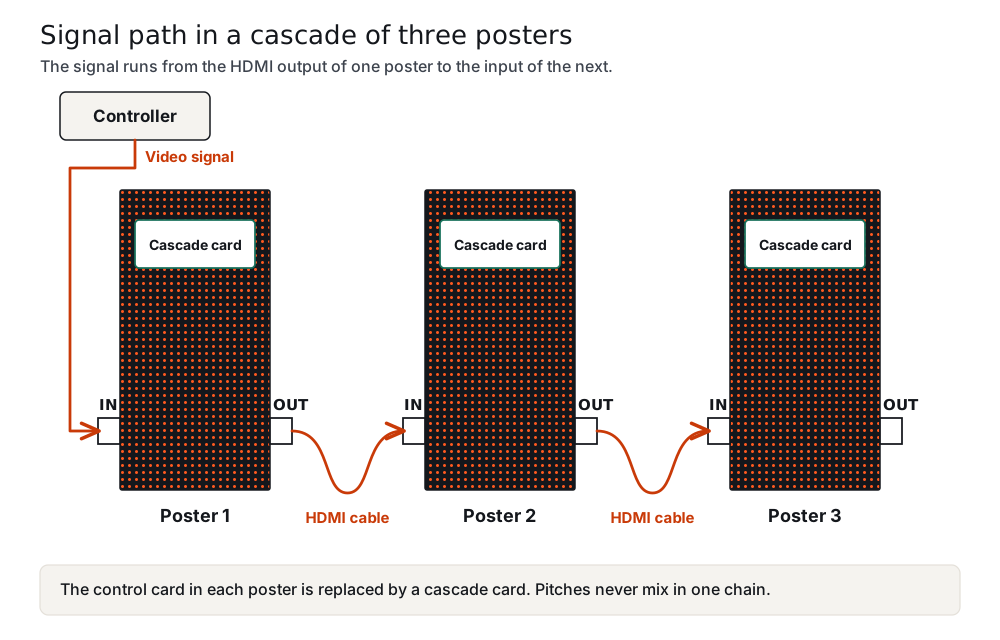
Joining LED posters into one wider screen is called a daisy chain or cascade. The video signal runs from the HDMI output of one poster to the input of the next, and the control card in each poster is replaced by a cascade card. This guide explains which posters can join and what sets the number.
- Die-cast, tri-fold, outdoor
- Pitches never mix
Which posters can be chained
| Type | Daisy chain |
|---|---|
| Die-cast LED poster, 640 mm and wide die-cast LED poster, 960 mm | Yes |
| Folding tri-fold LED poster | Yes, open, side by side |
| Outdoor LED poster, 640 mm | Yes |
| Double-sided LED poster | No |
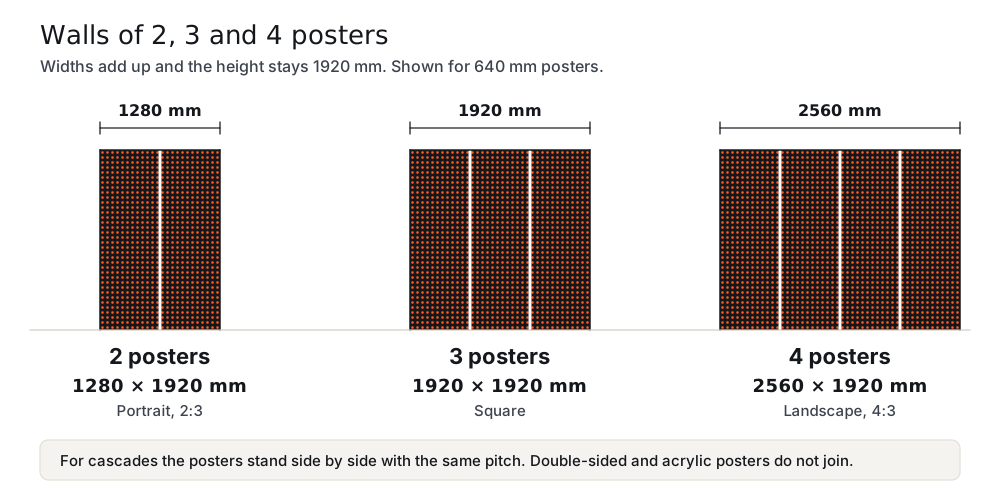
| LED poster with acrylic glass screen | No; the acrylic frame stands proud of the cabinet |
How it works
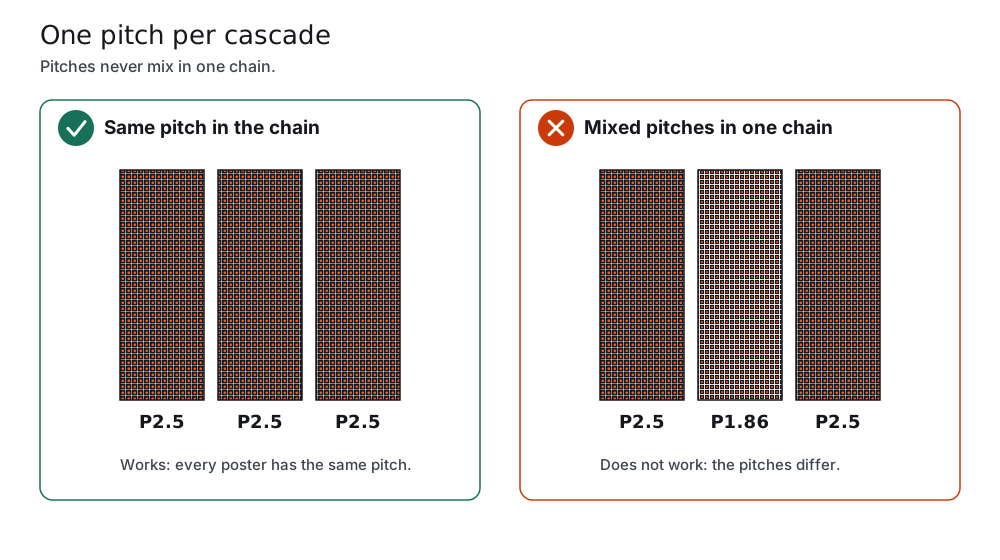
Posters stand side by side. The signal runs from the HDMI output of one poster to the input of the next. The cascade controller replaces the control card in each poster, so choose it when you order. Pitches never mix in one chain.
What sets the number of posters
The number of posters in one cascade is set by the total pixel count that the controller and its receiving cards can drive, so it depends on the pitch: a finer pitch puts more pixels in each poster, so fewer posters fit on one controller. At the same pitch a 960 poster has 1.5 times the pixels of a 640 poster and an open tri-fold twice as many. We calculate the number for your layout.
Chain limits (640 die-cast)
| Pitch | Posters in one cascade | Controller | Screen at maximum |
|---|---|---|---|
| P2.5 | up to 8 | NovaStar controller | 5120 × 1920 mm, 2048 × 768 px |
| P1.86 | up to 6 | NovaStar controller | 3840 × 1920 mm, 2064 × 1032 px |
| P1.25 | up to 6 | Huidu controller | 3840 × 1920 mm, 3072 × 1536 px |
For other pitches, types or a longer wall, tell us the width you need.
Pixels of 1, 2 and 3 posters
For 640 posters:
| Pitch | Viewing distance from | 1 poster (640 × 1920 mm) | 2 posters (1280 × 1920 mm) | 3 posters (1920 × 1920 mm) |
|---|---|---|---|---|
| P1.25 | 1 m | 512 × 1536 px | 1024 × 1536 px | 1536 × 1536 px |
| P1.538 | 1.5 m | 416 × 1248 px | 832 × 1248 px | 1248 × 1248 px |
| P1.86 | 2 m | 344 × 1032 px | 688 × 1032 px | 1032 × 1032 px |
| P2 | 2 m | 320 × 960 px | 640 × 960 px | 960 × 960 px |
| P2.5 | 3 m | 256 × 768 px | 512 × 768 px | 768 × 768 px |
| P3.076 | 3 m | 208 × 624 px | 416 × 624 px | 624 × 624 px |
The words
Daisy chain and cascade mean the signal path. Splicing means placing posters edge to edge so they read as one screen. Showing the same content on separate posters is synchronized playback and needs no chain. A cascade is for one picture across several posters.
Questions and answers
What is the difference between daisy chain and cascade?
They name the same thing here: the signal runs from one poster to the next.
Do I need a special cable?
The signal runs from the HDMI output of one poster to the input of the next.
What is a cascade card?
The card that replaces the control card in each poster so the posters can pass the signal on. Choose it when you order.
How many 640 posters can I chain at P2.5?
Up to 8 with a NovaStar controller, which is 5120 × 1920 mm.
Can I chain 960 posters?
Yes. The number depends on the total pixels the controller can drive; a 960 poster has 1.5 times the pixels of a 640 poster at the same pitch.
Can I mix pitches?
No. Pitches never mix in one chain.
Can I chain different types?
Posters of different cabinet types are not planned as one screen by default; tell us what you have in mind and we calculate what can be joined.
Can I add posters later?
Tell us what you have and we check whether the new poster can join it; they must have the same pitch.
Request a quote
Request a quote and tell us the type, the pixel pitch, the quantity, the destination country and your control system (NovaStar with Mean Well PSU by default; Huidu or Colorlight as a lower-cost option). Price, MOQ and lead time are quoted per order. Samples are available.