Blog
Single LED poster or a chain of posters: how to decide
A single poster is the simplest install. A chain of posters gives one wide picture. Both are valid, and the right choice depends on what you want to show and how people see it. This article lists the questions that decide it.
- Single
- Wall
- Cascades
Start with the picture
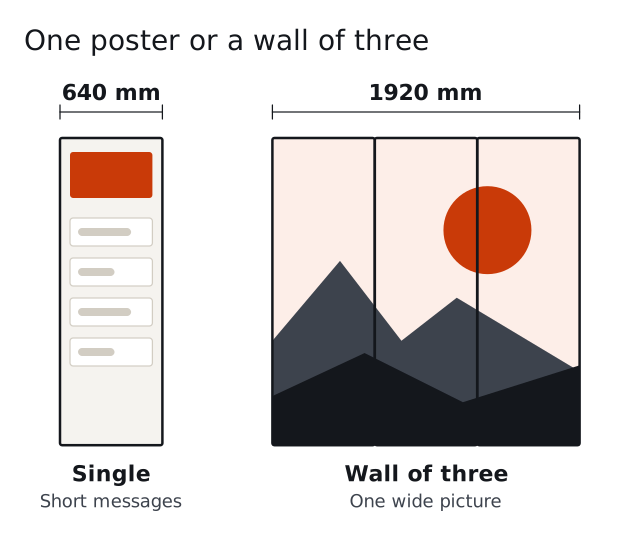
If your content is a stack of short messages, one portrait poster is enough. If you want one wide image, a film or a map, the width of a chain helps: two 640 posters make 1280 × 1920 mm, three make 1920 × 1920 mm. If you only need a wider portrait canvas, a single 960 poster may do. See the resolution guide for the pixel counts.
Check that the type can join
Die-cast, tri-fold and outdoor posters can be chained. Double-sided and acrylic posters stand alone. If you need the acrylic glass or the two faces, the answer is separate posters, each with its own content. The cascade guide has the table.
One pitch for the whole wall
Pitches never mix in one chain, so a wall is one pitch from end to end. Choose the pitch for the closest viewer first, then check how many posters your controller can drive.
Count the controller limit
The number of posters in one chain is set by the total pixels the controller and its cards can drive, so a finer pitch means fewer posters. For the 640 die-cast poster, a NovaStar controller joins up to 8 posters at P2.5 and up to 6 at P1.86, and a Huidu controller joins up to 6 at P1.25. We calculate other layouts for you. See the controllers guide.
Think about service and moves
A chain needs the posters to stand side by side, so check the space. Posters with rear service, such as the aluminium profile 640 with rear door, need 30 to 50 cm behind them, while die-cast posters are front service only. If the wall will move between venues, the tri-fold opens to 1280 × 1920 mm and folds to about 640 mm. See front service or rear service.
A simple way to decide
Write down the picture you want, the closest viewer and the width of the space. Then choose the pitch, divide the width by 640 mm or 960 mm, and check the controller limit. If the result is one poster, buy one. If it is a wall, request the cascade version of the controller.
Questions and answers
When is one poster enough?
When the content is a stack of short messages in portrait, such as a menu, an offer or a schedule.
When do I need a chain?
When you want one wide picture across several posters.
Can I start with one and add more later?
Plan this at the order. The controller and the cards of the poster must support the wall, and all posters must have the same pitch.
How do I compare a 960 poster with two 640 posters?
A 960 is 960 × 1920 mm in one cabinet. Two 640 posters make 1280 × 1920 mm and need a cascade. State both options in the request and the quotation compares them.
Can a chain include a 640 and a 960 poster?
Yes, if they have the same pitch and the types can be chained. The heights are the same, 1920 mm.
Can two posters show the same content without a chain?
Yes. Each poster plays its own stored content, so two posters can show the same files.
Does a chain need a computer?
No. The player holds the content and the cascade controller handles the signal.
What do I tell you for a wall?
The type, the pitch, the number of posters, the width you need and your control system.
Request a quote
Request a quote and tell us the type, the pixel pitch, the quantity, the destination country and your control system (NovaStar with Mean Well PSU by default; Huidu or Colorlight as a lower-cost option). Price, MOQ and lead time are quoted per order. Samples are available.